guidelines on HOUSE ALTERATIONS
A
Contents:
Maisemore
Gardens offers a remarkable combination of features: a real
community, a stunning coastal location and interesting
properties that offer modern, spacious accommodation.
Over time
the original design elements of the estate have been diluted
and the challenge now is to regain a more unified
appearance. The COM believe that this is essential to
maintain the structure of the estate, and should be
supported vigorously.
This
document has been produced to inform and encouraged
residents to maintain and improve their properties in
keeping with the original design ethos and terms of the
lease.
A
collegiate and collaborative approach will create an
atmosphere where making the right choices in window, doors,
paint colours and glazing etc. will be a benefit to the whe
community, maintaining and increasing the value of the
proper
2. Design Protocol
To
achieve the objective of maintaining the overall
standardised design of the properties, it is necessary to
establish what is recognised as the ‘original’ design, and
what is acceptable as a modern equivalent based on
sustainability, safety and modern design practice.
2.1
Windows
1. The
original windows were minimalist sliding or fixed panes
within a wooden framework. This design has now been
superceded by the use of modern uPVC frames holding hinged
double glazed panes.
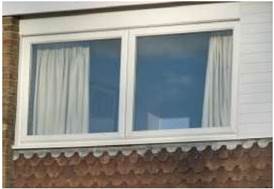
2. First
floor windows should be of identical size and function, have
minimal framing and large panes as shown below.
3. Ground
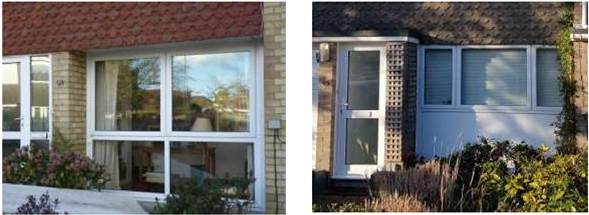
floor windows vary depending on the type of house.
Houses
with a large window to the right of the porch should follow
the basic design shown below left, a centrally divided upper
section and a lower section below the glazing bar which can
be glazed or panelled in white for security.
Houses
with smaller windows to either side of the door should
follow the line of the standard door whereby the base of the
window is level with the top of the door glazing bar.
2.2
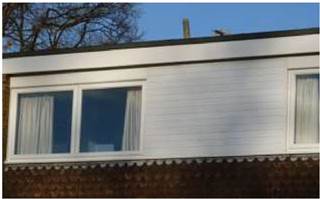
Fascia Boards
Fascia
boards were originally of plain render. When required these
should be replaced with white plastic panels, running
horizontally, approximately 6” deep, as shown below.
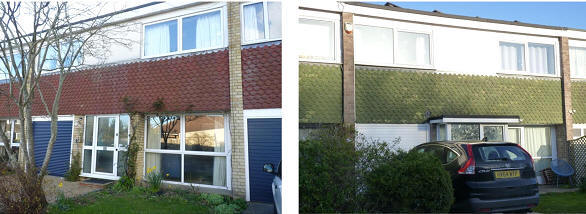
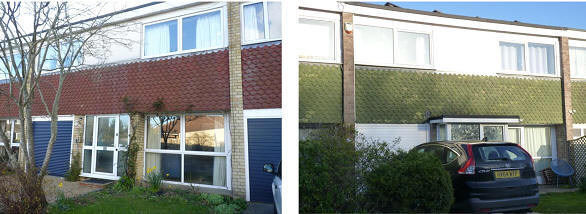
2.3 Tiles
The
original hung tiles must be retained in the appropriate
colour for each terrace, as shown
below.
2.4 Front
Door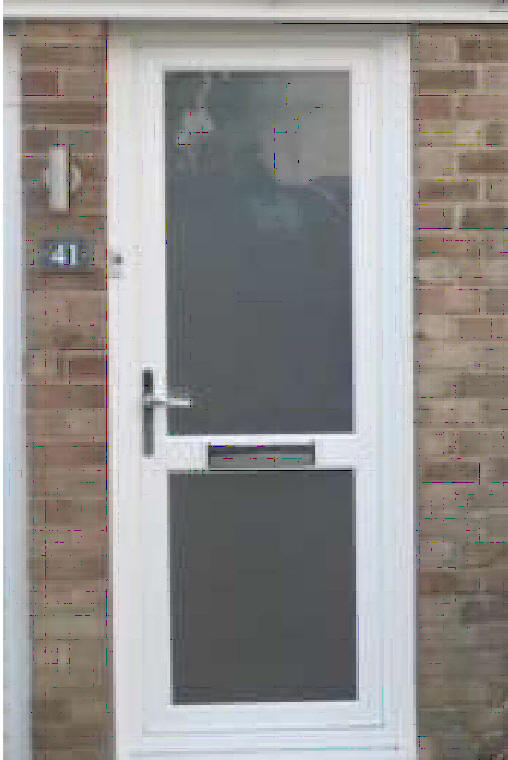
All
properties were originally built with front doors of one
design. These were plain glazed, with a structural cross bar
at a specific height and the option of replacing the lower
panel with a plain white blanking sheet. The
modern replacement should retain the basic design as shown
right. Modern materials such as white uPVC are acceptable,
glazing can be plain or translucent but any pattern
in the glass should be subtle.
2.5 Porch
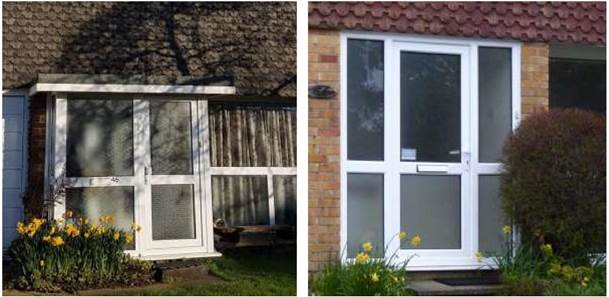
Where
porches are present they contain one pane with a glazing bar
at the standard height the standard door always to the right
as shown below left. The original wood construction can be
replaced with white uPVC structures with plain or
translucent glazing, the lower panel can be replaced with a
plain white panel for security.
 Some
properties have internal porches whereby the door is central
with windows either side. These have a glazing bar running
across the windows as a continuation of the door bar, see
below right. All designs should be appropriate for the
property type within the terrace in which the property is
located.
Some
properties have internal porches whereby the door is central
with windows either side. These have a glazing bar running
across the windows as a continuation of the door bar, see
below right. All designs should be appropriate for the
property type within the terrace in which the property is
located.
2.6
Garage Doors
Garage doors were originally paneled and glazed at the top.
Many of these have been replaced with a variety of up and
over designs and more recently with roller doors. It is
recognised that a standard design does not exist.
Replacement doors should have narrow horizontal ribs and be
of a minimalist un-glazed design, retaining the standard
colour for the terrace. Doors with horizontal ribs which are
divided vertically and are side hinged are approved.
A colour
guide is
available on the Maisemore Gardens website.
Changes to these standard colours
can only be made when all the owners in a terrace
agree to implementing the change.
Changes
to these standard colours can only be made when all the
owners in a terrace
agree to implementing the change.
2.7 Roofs
A consistent roofline should be maintained along a complete terrace. This retains the original minimalist look of the buildings and avoids potential drainage problems caused by changes in roof level. Unless a complete terrace agrees to change, replacement roofs should be of the ‘cold’ type with insulation under the roof boards.
2.8
Gutters and downpipes
The original flat roof design includes hidden gutters, set
back from the roof edge, that fed rain water into internal
down pipes which were linked into the estate’s drainage
system. These should be retained. New roofing felt must not
reduce the size of the openings into the original downpipes.
Where the efficiency of this system has decreased over the
years, the installation of external hopper and downpipes,
which must be connected to the estate’s surface water
system, is an accepted practice. Not every house will need
this and an excessive number of external downpipes is
discouraged. (They only replace the internal down pipe).
Installation of external gutters at the front of houses is
not acceptable.
2.9
Structural internal changes
The COM
must be informed of any planned structural modifications to
the internal framework and party walls of a property. This
is to ensure that any potential impact on a neighbouring
property (including party wall implications) is understood
and that the integrity of the building is not compromised.
2.10
Other equipment (solar panels, aerials...)
Any
equipment attached to the house (including the roof) visible
from the road has an impact on the estate’s overall
appearance. Such equipment should be placed as far back from
the road as practical to minimise the visual impact.
2.11
Front Gardens and Drives
The original design of the estate was to provide an open and undivided vista, uninterrupted by any object or structure. This included cars, caravans (motorised or not), boats, sheds, wheelie bins etc. As the majority of cars have increased in size, the COM accepts that it is preferable to keep cars on a drive rather than the highway. Trees and shrubs in front gardens should be low and under control to maintain this open feeling.
Proposed changes to the layout of
driveways must be submitted for consideration by the
Planning Group and approval by the CoM using the correct
process. Emphasis will be given to maintaining as much
garden area as possible, drainage requirements, and the
design and materials choices. Materials should be in keeping
with the original design and colour; tarmac and large areas
of block paving are discouraged. Increases in driveway width
which lead to a loss of garden area should be modest. No
extension will be authorized which increases the driveway
width past the outer corner of the porch.
2.12 Rear
Gardens
Rear
gardens are the only area within the estate where the
addition of buildings or extensions may be considered.
Approval by the COM and where appropriate, Havant Council
Planning, is required. Where replacement fencing is planned,
approval from neighbours should be sought.
3.
Procedure and Process for Alterations
The
Design Protocol and these notes on Procedure have been
complied to provide house owners and the COM with a
structured process to ensure that the conditions of the
lease are met when alterations are carried out.
The lease conditions are in place to:
-
Ensure that any change or addition to a dwelling does not or may not cause any nuisance, annoyance or inconvenience to any member.
That the overall uniform façade of the estate is maintained, as far as is
practical, as was originally designed.
3.1
Notification
Any planned
change to areas of a property described in the Design Protocol
must be notified to the COM in writing for approval. It is
strongly suggested that approval is sought before any funds, or
timings are committed to.
The
documentation should include a description of the proposed
changes together with outline drawings.
Materials and
fittings should be specified in detail.
Where the
changes, or installation of the changes, may have an impact on
any neighbour or member, the documentation should include
written acceptance from such households.
On receipt of
the documents, the COM will log the planned changes and review
the proposal. Where necessary a visit to examine and discuss the
implications of the change will be arranged. Each proposed
change will be identified and recorded by application date,
house number and brief description.
When the COM
are satisfied that the conditions of the lease are being
maintained, the proposer will be notified in writing. This
response may include caveats that need to be addressed. This may
include an appraisal to ensure all potentially impacted members
have been notified and written approval obtained. If deemed
necessary, the works may be visited to ensure that they have
been satisfactorily addressed.
This
application process will be managed by the COM in a short a time
as possible. If the change is recognised as following the Design
Protocol, the request can usually be turned round within a week.
Should the application need a committee meeting to resolve any
issues, it will be discussed at the next COM meeting. These are
scheduled to be in an eight week period.

|
Copyright © 2026 Maisemore Gardens Ltd All Rights Reserved.
Website Design: Emsworth
Online |